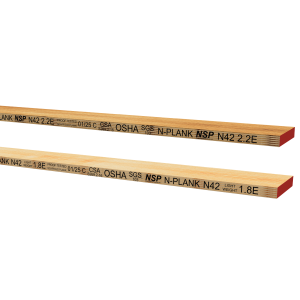
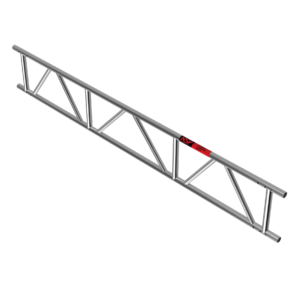
High-Strength Laminated Scaffold Planks for Demanding Job Sites
In modern construction and industrial environments, access platforms must deliver consistent load performance, dimensional stability, and long service life. Laminated scaffold planks are engineered to meet these requirements through controlled manufacturing processes that produce uniform strength across the entire span. Unlike traditional solid-sawn lumber, laminated planks are constructed from multiple layers of veneer bonded together under pressure, creating predictable structural performance in high-demand applications.
North Scaffold Products supplies precision-manufactured LVL scaffold planks designed for contractors who require reliable working platforms across commercial construction, infrastructure projects, and heavy industrial maintenance.
Why Contractors Choose LVL Scaffold Planks Over Solid Lumber
Conventional lumber planks can contain natural defects such as knots and grain inconsistencies. These variables often result in uneven load distribution and reduced structural reliability over time. LVL planks are manufactured using thin wood veneers oriented in the same direction, which significantly reduces variability and improves bending strength.
For project managers and site supervisors, this engineered consistency translates into measurable operational benefits. Crews gain a stable, predictable work surface that performs uniformly across multiple spans and elevations. This reduces mid-span deflection, improves worker confidence, and supports safer material handling at height.
Because laminated scaffold planks are produced under strict quality control conditions, they also offer improved dimensional accuracy. Uniform thickness and straightness simplify installation within ringlock, frame, and modular scaffold systems, minimizing gaps and uneven transitions between bays.
Engineered Performance for Construction and Industrial Access
On active job sites, scaffold planks are exposed to repeated loading cycles, impact from tools and materials, and environmental stress. Engineered LVL scaffold planks are designed to handle these stresses without the unpredictable weaknesses found in standard boards.
The structural design of LVL planks allows them to maintain strength over longer spans while reducing the risk of sudden failure due to hidden defects. This is particularly important on high-traffic platforms where concentrated loads from masonry, mechanical equipment, or bundled materials are common.
For industrial maintenance projects in refineries, power plants, and processing facilities, reliable platform performance directly affects crew efficiency. Stable, high-capacity laminated scaffold planks support safe movement and tool operation, reducing downtime and improving workflow continuity.
Consistency That Supports Regulatory Compliance
Safety regulations in Canada and the United States require scaffold platforms to support intended loads without excessive deflection or failure. Using engineered LVL scaffold planks helps contractors meet these requirements with greater confidence.
Because LVL planks are manufactured to defined structural standards, load performance is more predictable compared to traditional lumber. This predictability simplifies engineering calculations and scaffold design planning. When paired with compliant guardrails, proper bracing, and secure supports, laminated scaffold planks form part of a complete, regulation-ready access system.
For companies operating across multiple provinces or states, consistent plank performance reduces variability between projects and helps maintain standardized safety procedures.
Long-Term Value Through Durability and Reusability
Cost efficiency in scaffolding is not based solely on initial purchase price. It is measured by lifespan, maintenance requirements, and performance reliability over repeated project cycles. High-quality laminated scaffold planks maintain structural integrity longer than many traditional alternatives, reducing replacement frequency and lifecycle costs.
The durability of engineered LVL scaffold planks makes them a practical choice for contractors managing large equipment inventories. Over time, this translates into stronger return on investment and fewer disruptions caused by plank failure or excessive wear.
When platform safety, predictable strength, and long-term performance are critical, engineered LVL planks provide a dependable solution.
North Scaffold Products delivers professionally manufactured laminated planks designed to support safe, efficient, and compliant access systems across construction and industrial job sites.